

Workplace Safety/Occupational Health and Safety

Health and Safety Policy
- In line with our Behavioral Guideline, "Always Put Safety First," all employees will work together to promote safety and health activities.
- Based on the principle of respecting human life, we will establish necessary internal standards, comply with laws and regulations, and aim to create a safe, healthy, and comfortable working environment.
- We will promote good communication both inside and outside the company and contribute to ensuring the safety and health of all our stakeholders both internally and externally.
- All employees will strive to identify potential hazards in the workplace from their own perspective and contribute to risk reduction in order to prevent accidents and disasters and ensure their health.
Health and Safety Management System
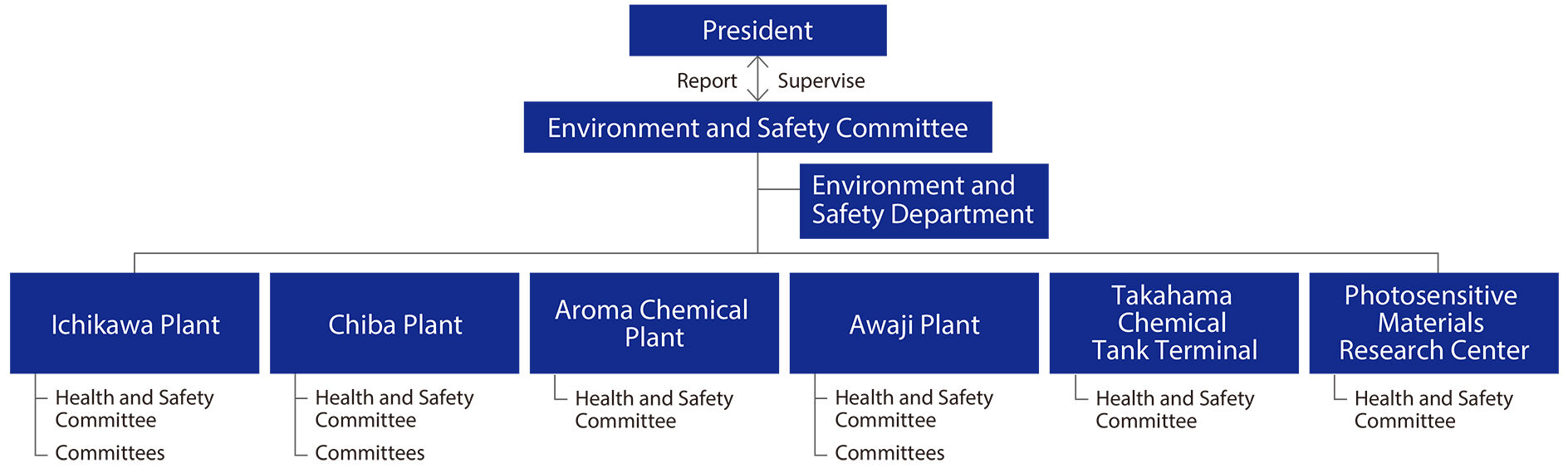
At Toyo Gosei, the president serves as the Chief Health and Safety Officer (CHSO), and we have established a health and safety management system that complies with laws and regulation. Through this system, we promote occupational health and safety (health and productivity management).
The Environment and Safety Committee, which oversees safety and health activities across the company, is composed of the president, division managers, the heads of each business location, and the environment, safety, and health managers from each business location. The committee meets once a year to formulate policies and plans and discuss the prevention of occupational injuries. The committee reports to the Environment and Safety Department and shares the results with health and safety committees of each business location.
The Health and Safety Committee at each business location is composed of the head of the business location, the health and safety manager, health and safety committee members selected from the management team and employees, and representatives from partner companies. The committee meets monthly. Members of the Environment and Safety Department also participate in the committee, sharing details of activities and discussing countermeasures for problems and reporting to the Environment and Safety Committee.
Information on the matters discussed in each committee and rules regarding health and safety are posted on the intranet so that all employees can view them. Meeting minutes are distributed to partner companies to keep them informed.
Furthermore, to ensure the safety of all employees, we require partner companies to establish a safety management system when we enter into a contract with a partner company. We also incorporate partner companies into our safety management system. Partner companies proactively promote safety and health activities in their own capacity.
Target
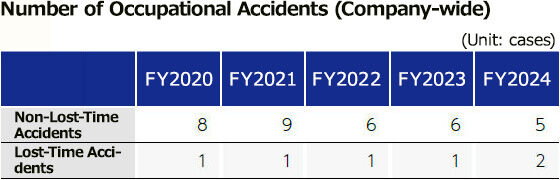
We implement health and safety activities following our Health and Safety Policy. Our goal is to always achieve zero accidents resulting in lost time or no lost time every year.
Situation of Occupational Injuries
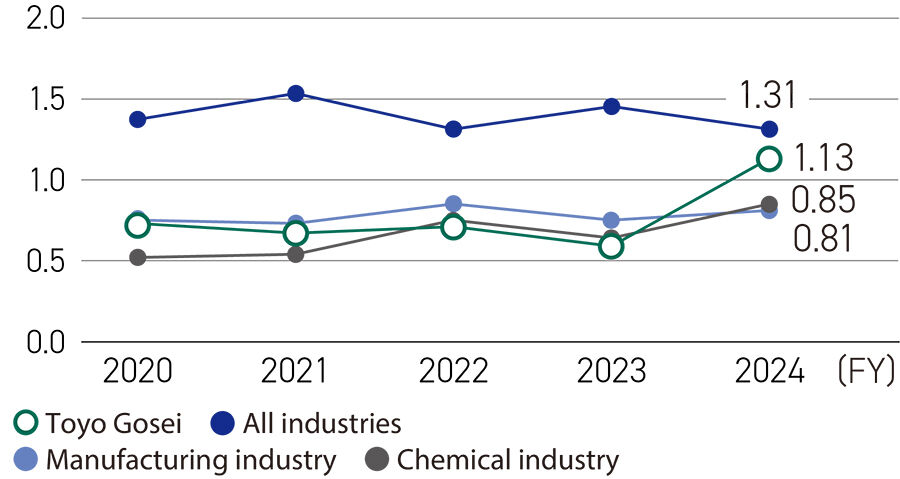
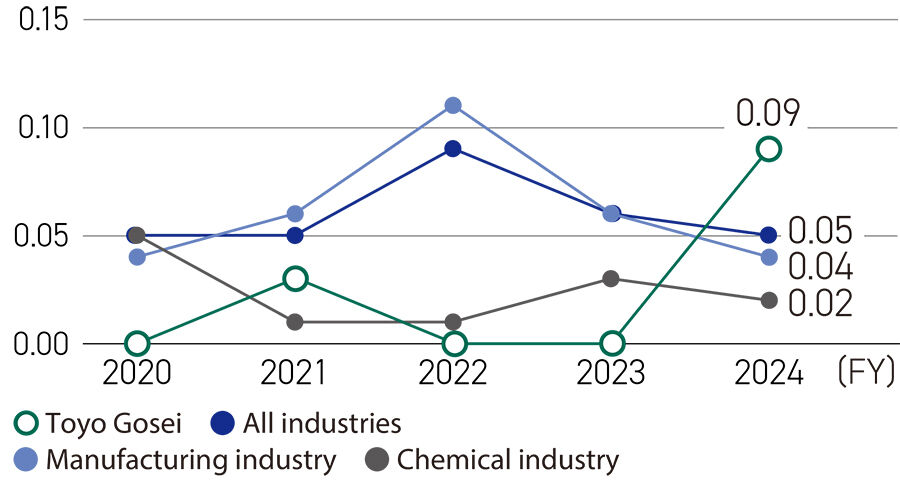
Taking seriously the lost-time accident that occurred during high-place work that occurred in FY2024, which led to an increase in the severity rate of occupational accidents, we have revised our safety guidelines for non-routine tasks and implemented measures to prevent recurrence that are tailored to the workplace. These efforts have also been praised as effective by the Labour Standards Inspection Office.
Going forward, we will continue to listen to feedback from our frontline operations and further strengthen our stance of prioritizing safety.
Trend in Occupational Accident Frequency Rates
Risk Assessment
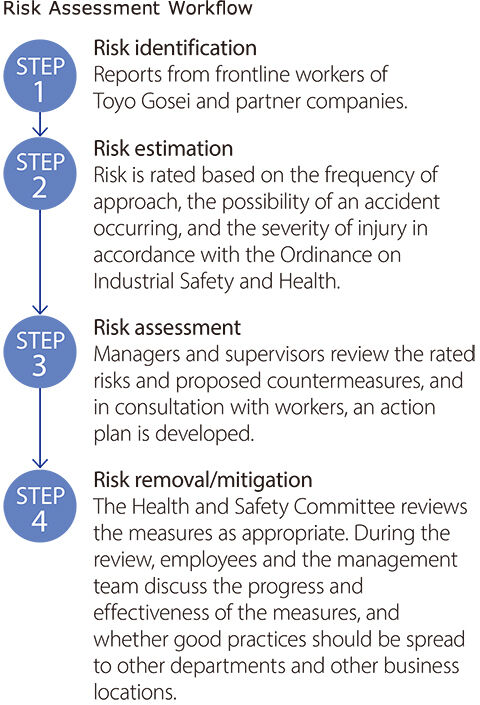
We conduct risk assessments using our Occupational Safety and Health Management System (OSHMS). We share risks and countermeasures across each business location to improve their effectiveness.
Risk Assessment of Chemical Substances
At Toyo Gosei, we believe that the safe handling of chemical substances is a fundamental professional skill and prioritize employee operational safety. We conduct risk assessments for all chemical substances using the CREATE-SIMPLE* tool, and based on the results, we implement mitigation measures such as installing ventilation systems, improving work methods, and using protective equipment as needed. We also have the skills to determine and implement appropriate methods for selecting and using chemical-resistant protective gloves. Our research and development departments conduct more advanced risk assessments for new chemical substances and processes to ensure safety in advance. These activities are carried out under the autonomous chemical substance management system required by the Industrial Safety and Health Act, fostering a culture of safety and realizing safe and reliable manufacturing.
* CREATE-SIMPLE: A chemical substance risk assessment support tool developed by the Ministry of Health, Labour and Welfare that targets health risks caused by inhalation and dermal exposure and dangers (flammability, explosiveness, etc.).
Activities to Prevent Occupational Accidents
Safety Patrols
At our business locations, we conduct safety patrols to help eliminate occupational accidents. Any problems discovered during these patrols are reported to the Health and Safety Committee, the Workplace Health and Safety Conference, and the Company-wide Environment and Safety Department Liaison Meeting. In turn, improvements are promptly implemented.
●Mutual Safety Patrols Between Business Locations
We conduct safety patrols monthly at each of our business locations. During these particular patrols, participants are invited from other business locations, who gather to identify issues from multiple perspectives. The good practices and countermeasures learned from the patrol are brought back to each of their business locations and implemented, promoting mutual safety. In addition, past occupational accidents that occurred in the patrol area are reviewed on-site to confirm whether the past countermeasures remain effective and if they can be applied elsewhere. Regular assessments are also carried out to contain occupational accidents.
●Safety Patrols by Top Management
Safety patrols by top management are conducted monthly at each business location, with the management team (president, division managers, plant managers) carrying out inspections based on themes such as business topics, risk assessment, investment plans, concerns raised by on-site workers, unresolved cases, and non-routine work. This allows for swift decision-making to improve each issue, leading to improvement at an early stage. The purpose of these patrols is also to promote interaction between management and on-site workers. By having management think about issues together with on-site workers, these patrols have led to a positive sense of tension and improved safety awareness, which has been highly praised on-site.
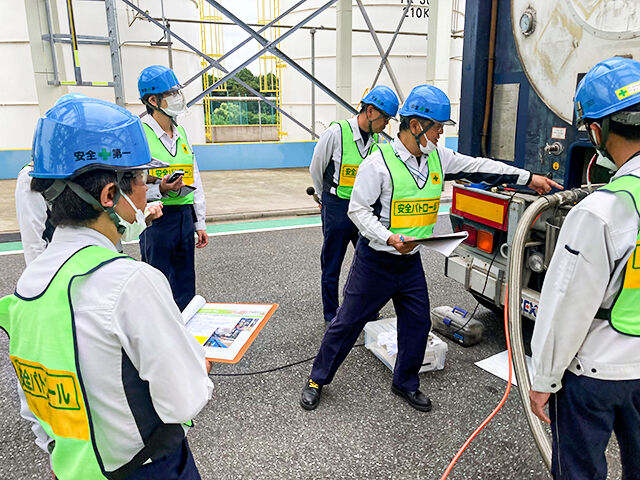
Interactive safety patrol with participation from each business location (Aroma Chemical Plant)
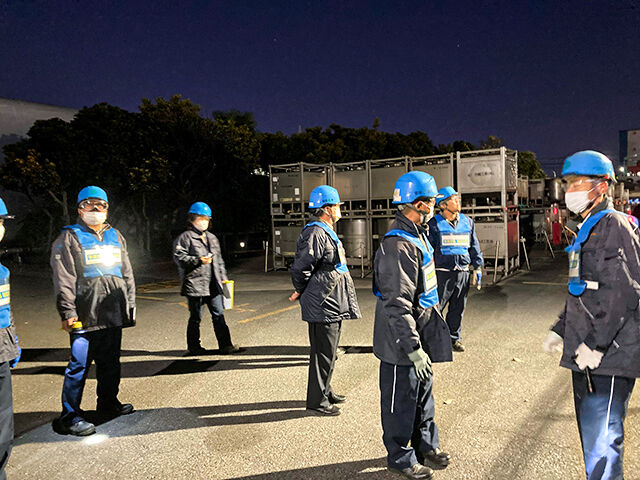
Nighttime patrols to check for dangers that occur only at night (Ichikawa Plant)
Initiatives to Prevent Static Electricity Accidents
Due to the nature of our business, which involves handling volatile substances, we require an advanced level of management to prevent the risk of equipment failures or ignition caused by static electricity. To address this, we are working to maintain a safe and stable production environment through design and operation that eliminates the generation of static electricity and through employee education.
Several of our employees are certified as static electricity experts by the Technology Institution of Industrial Safety and their knowledge and skills are used in our safety management practices. In addition, employees are required to wear special protective clothing and shoes designed to prevent static electricity. We always test these before work to ensure that their performance is maintained.
Through these safety management measures, we strive to prevent accidents caused by static electricity. We are also working to develop experts and pass on knowledge and skills to ensure that appropriate safety management can continue in the future.
Initiatives to Eliminate Human Error
An analysis of the occupational accidents that occurred at Toyo Gosei in FY2024 showed that the number had increased slightly compared to the previous fiscal year, but the majority were due to human error. Digging deeper, we found that human error was caused by deficiencies in equipment, procedures, and operations.
Human error is not necessarily the fault of people. There are always hidden factors that induce mistakes and it is important to confront these. We analyzed the mechanisms of human error from the perspectives of memory, cognition, judgment, and behavior, and developed an internal checklist with countermeasures based on 10 elements. When a problem occurs, we use the checklist to conduct an initial joint investigation with the relevant departments on-site.
Safety Activities with Partner Companies
Many partner companies are involved in on-site work at the Takahama Chemical Tank Terminal. In order to prevent occupational accidents, we launched the Protective Equipment Wearing Promotion Project in FY2023, a project which is still ongoing. We have established rules for the appropriate wearing of protective equipment to ensure the physical safety of all workers. We are not only working to increase the rate of employees wearing protective equipment by selecting appropriate solutions, visualizing the wearing status, educating employees on the need to wear it, and listening to the voices of those on-site, but also supporting partner companies in developing a workplace environment and creating opportunities to increase motivation so that they can seriously address issues and move towards independent operation.
Training and Education
Safety Awareness Training
At each of our business locations, we regularly conduct safety awareness activities, in which employees themselves research and plan activities and educate other employees about safety.
●Static Electricity Training
Due to the nature of the products we handle at our business locations, there is a risk of static electricity ignition. To ensure static electricity safety management and prevent accidents, employees, including static electricity experts, personally conduct static electricity safety training. When creating training materials every year, we gather information such as recent static electricity incidents and surveys, static electricity-related issues, and new company-wide rules, resulting in training content that is tailored to the needs of employees on-site. We also provide a forum for discussions during training to address issues in the places where trainees handle products, improving the sense of ownership together with our partner companies.
●First Aid Training
In preparation for emergencies, we conduct first aid training at each of our business locations with the cooperation of the fire department, where participants learn how to perform cardiopulmonary resuscitation and use an AED. AEDs are installed at our business locations, but at locations where training by the fire department is not possible, employees acting as first aid instructors provide education and training on how to use them.
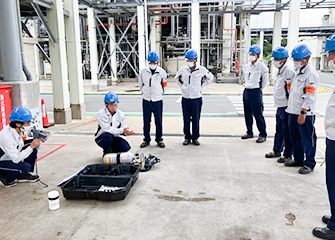
First aid training
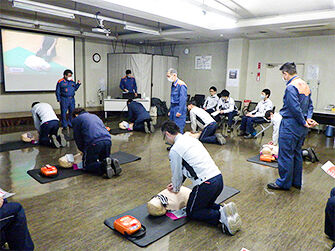
First aid training
●Safety Training for Tanker Truck Drivers
Our Takahama Chemical Tank Terminal receives over 100 tanker trucks per day. Loading chemicals is a collaborative effort with the drivers and safety at the terminal is maintained through cooperation between all parties involved. For this reason, at the Takahama Chemical Tank Terminal, we conduct safety training for tanker truck drivers once a month on Safety Enhancement Day before the start of loading and unloading operations as part of our safety awareness activities. This initiative has been rolled out company-wide.
Additionally, in preparation for any emergency, the Takahama Chemical Tank Terminal is equipped with a tank loading temporary suspension device (nicknamed "Tomaru-kun") that can immediately stop loading and unloading by pulling the emergency stop wire on top of the tanker truck. We conduct training once a year on how to operate Tomaru-kun as part of our safety awareness activities for shippers and transport companies, where they experience how the device works and foster awareness that they can operate Tomaru-kun without hesitation in an emergency. In addition, we also conduct overflow demonstrations using a real tanker truck to deepen the understanding of safety among truck drivers, and thoroughly prevent overflows and occupational accidents in case of an emergency.
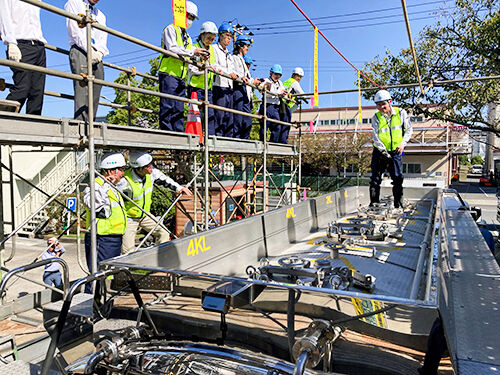
Experiencing an overflow using an actual tank filled with water at Takahama Chemical Tank Terminal
Interactive Safety Training
To further enhance awareness of safety, we conduct interactive safety training at each of our business locations, where employees can experience dangerous situations firsthand. In FY2024, we conducted leak experience training at the Aroma Chemical Plant, simulating a leak onto the road during loading and unloading from a tanker truck. This training involved pouring water onto the road and implementing initial response measures to prevent further spillage. This practical training, conducted
for participants including our partner companies, covered the actual speed of water flow, the positioning of tools for cleaning up accumulated spill, the use of protective equipment to prevent chemical injuries, and response methods. At our Awaji Plant, we conduct interactive training on the use of fall arrest devices and safety blocks (extendable fall arrest devices) to prevent falls when working at height. Participants experienced being suspended in mid-air using a fall arrest device, experiencing the difference in load between abdominal and waist-mounted devices, and thereby recognized the importance of wearing the device.
Through interactive safety training, participants gain an understanding of how to respond in an emergency and confirm the importance of handling safety equipment, further increasing their awareness of the importance of wearing protective equipment to safeguard themselves in the event of an emergency.
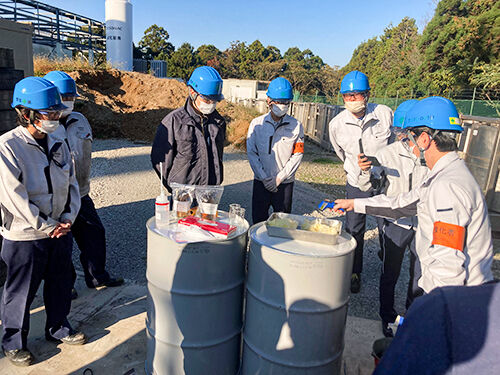
Experiencing oxidation heat by soaking a cloth in solvent (Aroma Chemical Plant)
Safety and Disaster Prevention
Emergency Response System
In the event of a large-scale natural disaster, we have established an emergency response system that will set up an Emergency Response Headquarters headed by the President and Representative Director.
Actions to be taken in an emergency are summarized in the Business Continuity Plan Implementation Standards, which are posted on the intranet and readily accessible by all employees.
Disaster Prevention Training
Each of our business locations--Ichikawa Plant, Chiba Plant, Aroma Chemical Plant, Awaji Plant, and Takahama Chemical Tank Terminal--has its own fire brigade and regularly conducts various training exercises tailored to the location's characteristics in preparation for emergencies. In addition, we conduct safety confirmation drills using our safety confirmation system once a year across the entire company to ensure we are fully prepared for emergencies.

Water cannon training (Ichikawa Plant)
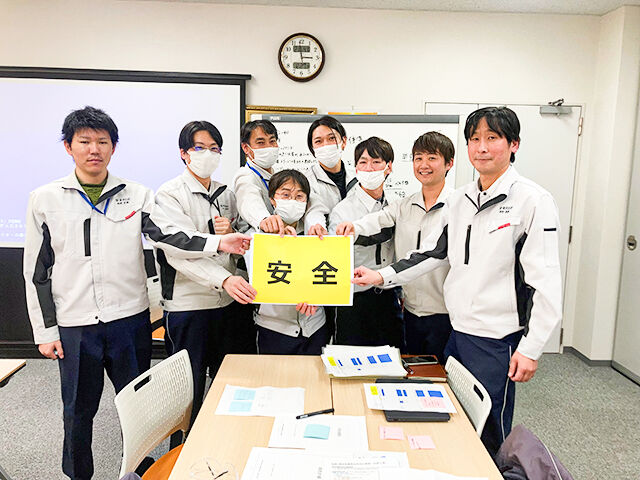
Tabletop training conducted to ensure safety in the event of a power outage (Awaji Plant)
Business Continuity Management
Health and Productivity Management
Aiming to create a workplace where employees can work with peace of mind as well as maintain their physical and mental wellbeing, we have been monitoring the health of all employees for many years together with industrial physicians. We explore and promote health-related measures based on factors such as the workplace, the age composition of the workplace, and the workload.
Improving Employee Health
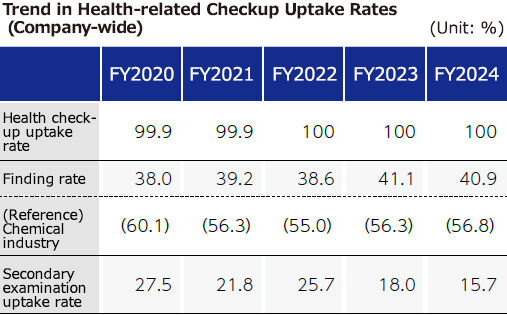
The health checkup uptake rate has remained at 100% since FY2022. However, we recognize that the uptake rates for secondary examinations and specific health guidance remain an issue and are working to improve them. Until now, industrial physicians have sent letters informing employees of the need to take secondary examinations and confirming their attendance, as well as warning employees about lifestyle-related diseases and providing information on hospitals. In FY2025, we plan to hold information sessions to communicate the need for secondary examinations and specific health guidance, so that employees recognize the importance of their health and take ownership accordingly.
Health Strategy Map
https://www.toyogosei.co.jp/images/second/csr/pdf/ senryakumap-2025.pdf
Mental Health
We conduct stress checks once a year for all full-time employees.
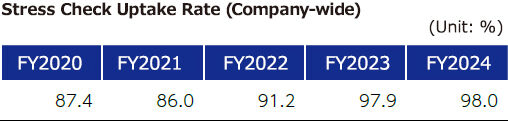
As a result of all employees working on Health and Productivity Management (HPM), each employee has become increasingly health-conscious, and the stress check uptake rate is increasing year by year.
Additionally, with the aim of promoting&understanding and preventing mental health issues, we hold seminars by industrial physicians and e-learning training every year.
At the same time, we have set up a consultation desk where industrial physicians and industrial health counselors can provide health consultations, striving to create an environment where employees can comfortably seek advice.
Furthermore, if an employee takes a leave of absence due to mental health issues, an industrial physician regularly checks the employee's physical and mental condition upon and after their return to work. The industrial physician will also work with their supervisor to support the employee in returning to work in a manner that is comfortable.
●Measuring Presenteeism
We began measuring presenteeism in FY2024. Rather than simply quantifying one's own performance, we added our own unique questions to help employees focus on the factors that lead to higher performance, think about what they can do to further their growth, and put those ideas into action. We also conducted individual interviews and consultations with certain employees to provide support for improving mental health and work environment issues, which has resulted in benefits beyond simple measurement.
Certified as 2025 Outstanding Organization of KENKO Investment for Health
Recognizing that the physical and mental health of our employees is an important management resource, we are working to create a comfortable working environment by strengthening various personnel policies, enhancing employee benefits, and implementing health policies unique to each business location. As a result of these efforts, we have been certified for the second consecutive year as an Outstanding Organization of KENKO Investment for Health (Large Enterprise Category) by the Ministry of Economy, Trade and Industry and the Nippon Kenko Kaigi.
In FY2024, we began measuring presenteeism and further increasing the use of our health strategy map and the dissemination of information on health and productivity management initiatives both inside and outside the company. Each business location proactively implemented creative and innovative health promotion initiatives, such as introducing salad bars to cafeteria menus and hosting health events such as yoga and long jumping rope. Furthermore, we collaborate with partner companies to hold various events aimed at improving health management and safety awareness, in an effort to promote mental and physical well-being throughout the workplace.

TOPICS
Creating Materials for In-house Seminars aimed at Health Support
As part of our health and productivity management initiatives, we hold seminars for all employees using informative materials prepared by our industrial physicians and industrial health staff. The seminar themes are determined annually based on the results of employee surveys and other factors, focusing mainly on men's and women's health and mental health. Because our industrial health staff want to make the seminars easy for employees to understand and engage with, they plan and create the content themselves, rather than relying on existing materials. After the theme is decided, our industrial physicians and industrial health staff brainstorm, create materials from scratch, and hold rehearsals before the actual seminar.
In FY2024, we held company-wide seminars on the themes of men's and women's menopause and stress magnitude, with a total of approximately 360 participants.
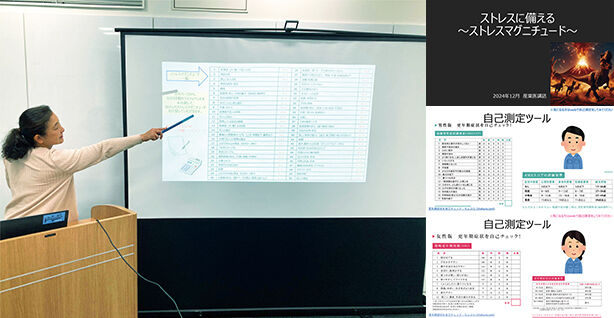
Seminar
Stress Check Uptake Rate (Company-wide)
スクロールできます| FY2020 | FY2021 | FY2022 | FY2023 | FY2024 |
|---|---|---|---|---|
| 87.4% | 86.0% | 91.2% | 97.9% | 98.0% |
Trend in Health Checkup Participation Rate
スクロールできます| FY2020 | FY2021 | FY2022 | FY2023 | FY2024 |
|---|---|---|---|---|
| 99.85% | 99.87% | 100% | 100% | 100% |
Trend in Percentage of Employees with Findings
スクロールできます| FY2020 | FY2021 | FY2022 | FY2023 | FY2024 | |
|---|---|---|---|---|---|
| Toyo Gosei | 38.0% | 39.2% | 38.6% | 41.1% | 40.86% |
| Chemical Industry Average | 60.1% | 56.3% | 55.0% | 56.3% | 56.8% |
Average Number of Sick Leave Days Due to Injury or Illness (All Employees)
スクロールできます| FY2020 | FY2021 | FY2022 | FY2023 | FY2024 |
|---|---|---|---|---|
| - | - | 1.8日 | 0.6日 | 2.0日 |
Presenteeism(State in which productivity is reduced due to health issues; measurement method: SPQ)
スクロールできます| FY2020 | FY2021 | FY2022 | FY2023 | FY2024 |
|---|---|---|---|---|
| - | - | - | - | 15% |
Health Strategy Map
(Japanese version only)
- Message from CEO
-
TOYO GOSEI REPORT2025 DOWNLOAD
(Japanese version only) - Toyo Gosei Co., Ltd. in Our Lives
- Toyo Gosei's Business and Sustainability
- Safety Initiatives
- Human Capital Initiatives
- Initiatives for Respecting Human Rights
- Social and Environmental Initiatives
- Initiatives for Business Continuity
- Initiatives for Sound
Corporate Management - Research and Development
- Sustainability Data