

Human Resources Development Underpinning Sustainable Growth

Basic Human Resources Policy
- Challenging Spirit
We evaluate and fairly reward employees who have a challenging spirit, overcome difficulties, and produce innovative results. - Proactive Human Resources Development
We support employees who actively work to improve themselves for their own career development. - Open and Fair
We advance efforts openly to ensure objective, fair, and highly reliable results. - Safe and Comfortable Workplaces
We develop workplaces and systems that allow employees to work with peace of mind.
Positive Relationships and Competitiveness Created from Human Resources Development
 Executive Officer
General Manager, Human Resources Department
Hideki Shibuya The Company continues to grow as a leader in global niche markets, with the world's top market share in materials for cutting-edge semiconductors, including photosensitive materials, and also in specific materials for synthetic fragrances. This growth is supported by the power of our people, and in order to remain competitive in the future, it is essential that we develop human resources in a way that maximizes the capabilities of each individual and fosters relationships.
We view human resource development as an important process for deepening each individual's self-understanding and understanding of others, as well as building quality relationships. Rather than acquiring short-lived or temporary skills, we believe that understanding one's own strengths and weaknesses, as well as one's own habits of thinking and judgment, and generating synergies as a team based on an interest in, understanding, and respect for others, will lead to the creation of a truly competitive organization.
Personnel System
Design Philosophy of Personnel System Supporting Human Resources Development
As a foundation for human resource development, our personnel system must not simply focus on system design or rule establishment but must be one that allows each employee to feel that they are growing and contributing. Rather than a system that exists only as a formality, we place importance on it being a system that people who need it will naturally want to use at the right time (i.e., a system that becomes popular). Furthermore, our personnel system is designed and operated based on the following three perspectives.
1. Personnel system linked to management philosophy and management strategy
Based on our management philosophy and strategy, our personnel system is designed as a mechanism for realizing our strategy. We clarify the personnel requirements necessary for business growth and support them with a consistent structure for expectations, training, and evaluation to achieve this. In turn, this ensures consistency between our personnel strategy and management strategy, and aims to ensure that the system functions organically as a force on the ground.
2. Desired talent profile linked with system elements
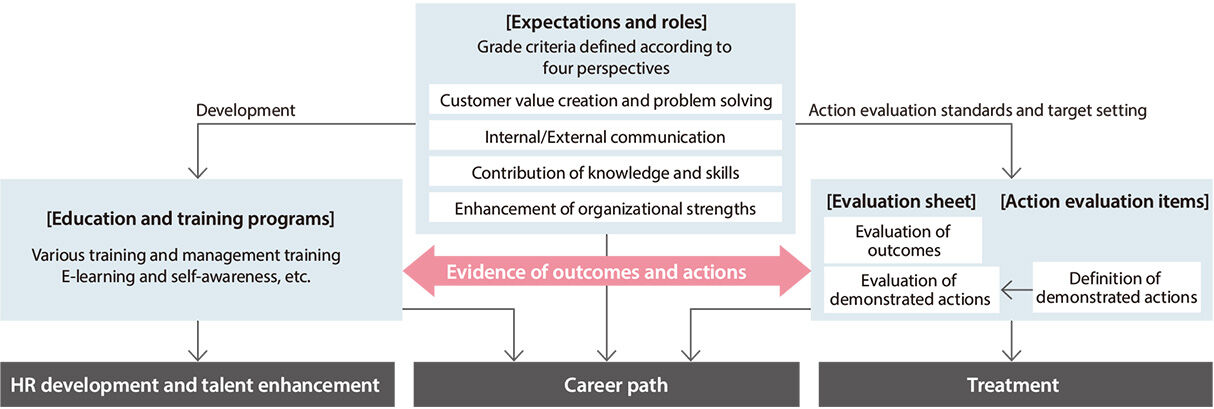
Our goal is to create people who can bring value to the organization through challenges based on self-understanding and collaboration with others. To realize this vision of human resources, our personnel system organically links the following three elements.
- Clarifying expectations and roles
We define the expected roles required for each job type and job grade, and clearly state what constitutes outcomes and what actions will be evaluated. This allows employees to act autonomously with a sense of direction. - Education and training
We provide educational programs to develop the skills and mindset required for each grade (career stage) based on defined expected roles. Starting with individual self-understanding and motivation for growth, we create a learning cycle through dialogue with supervisors. - Evaluation sheet and evaluation of actions
Based on an evaluation sheet that takes into account expected roles and educational outcomes, evaluations are conducted with a balanced focus on outcomes (What) and process (How). Evaluations are an opportunity for feedback linked to actions and are used as a mechanism to encourage growth.
3. Fair and transparent implementation and treatment
A personnel system can only gain the trust of employees if it is implemented fairly and transparently. At the Company, grades, evaluations, and treatment are based on clearly defined standards and are implemented through convincing dialogue with superiors. Furthermore, under our open and fair personnel policy, we strive to disclose evaluation results and the basis for treatment as much as possible, so that each employee can experience a sense of personal growth.
We believe that a personnel system should not simply be a means of organizational control, but a platform for co-creation that simultaneously promotes employee growth and organizational evolution. We will continue to pursue personnel management that supports employee success from both perspectives of systems and operations.
Personnel System Structure
Human Resources Development
Fundamental Approach
Based on the fundamental beliefs that all employees are capable, and everything depends on their development, a company is a place that provides growth, and unlocking people's potential, the Company is implementing various measures with the aim of not only promoting the growth of individuals, but also growing as an organization through the co-creation of these individuals.
Balancing Organizational Growth and Human Resources Development
Specific measures we are implementing include "Creating Vibrant Workplaces," which aims to balance organizational growth and human resource development by regularly monitoring the state of the organization and improving the work environment; "Long-Term Growth Support Plans," which enable employees to continuously acquire skills at each stage of their career based on their own career autonomy; "Career Development Support," which aims to increase the overlap between societal needs and each employee's aspirations and areas of expertise; and "Development Cycle of Planning and Review," which provides continuous support for improving skills and careers based on targets set by each employee.
●Organizational Development and Human Resources Development (Creating Vibrant Workplaces)
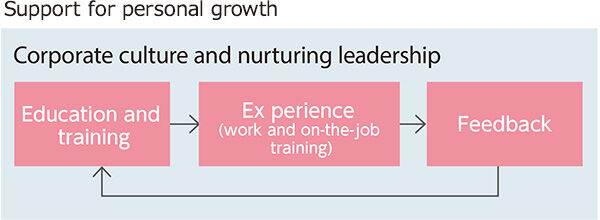
We define a "vibrant workplace" as one where individuals can achieve their potential with a sense of fulfillment. To achieve this, we need both an organization-wide approach (organizational development) and an approach focused on the individual (career development plus skill building). For organizational growth, department heads are required to manage the organization in a way that balances the achievement of organizational goals with human resource development, and we have identified five areas for strengthening and are advancing initiatives. For individual growth, we are implementing measures to encourage career development and skill building.
| Organizational Growth--Five Areas to Strengthen |
|
|---|
●Supporting Long-Term Growth
Off-The-Job Training
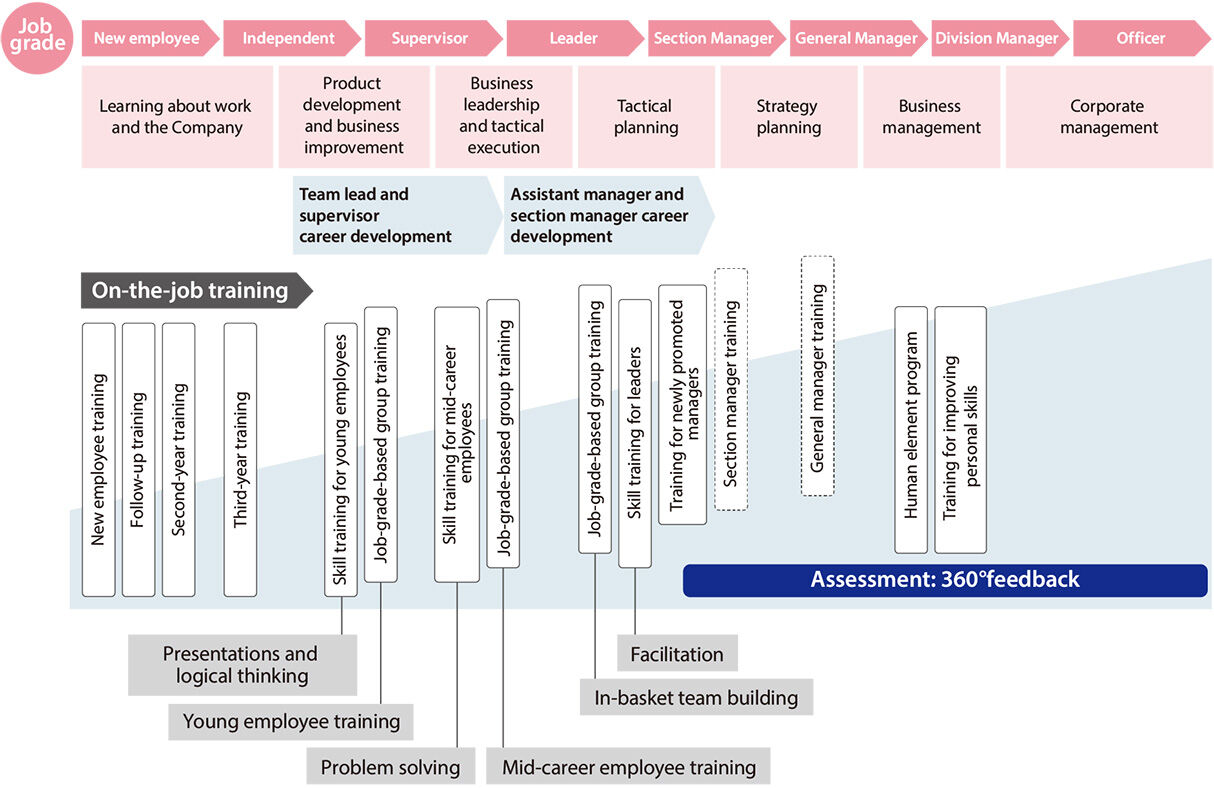
Recognizing that establishing a career perspective that will serve as the foundation of growth is critical, from a long-term perspective, from new employees to senior management, we define the skills required at each stage and provide learning opportunities to support their long-term growth. In addition, the average annual training cost per employee for training organized by the Human Resources Department was 67,000 yen in FY2024.
On-The-Job Training
We have introduced one-on-one on-the-job training to support practical human resources development through work. We also provide education on teaching skills to make this on-the-job training more effective and to improve safe production activities and human resources development capabilities in the workplace. Employees with trainer qualifications instruct on-the-job training personnel in the "four stages of teaching," and the training personnel then use these methods to teach new employees how to do their jobs.
●Career Development Support
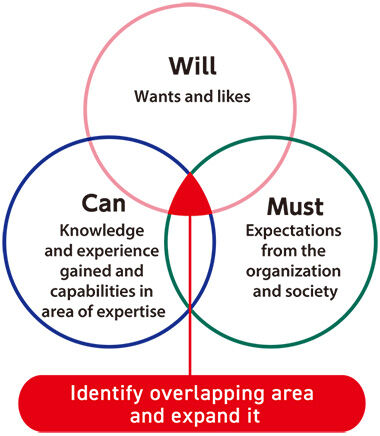
We have established a Career Self-Declaration System in addition to target management interviews with supervisors twice a year for all employees as an opportunity to hear about employees' career aspirations. Our career development uses a framework to specify what individuals want to do (Will) and what they can do (Can), take stock of their knowledge, experience, and areas of expertise, and understand the overlap of the "three circles" with what is expected of them by their supervisors, organization, and team (Must). Supervisors and subordinates work together to formulate development plans to maximize this overlap. To understand the environment surrounding one's career (life) and get closer to one's ideal self, we offer career training, skills training to improve the skills needed to get closer to one's ideal self, and e-learning for self-development as opportunities to experience the importance of responding flexibly to changes in the surrounding environment and taking the initiative to tackle these issues.
We also have an internal recruitment system that allows employees to apply for open positions, supporting employees in building their own careers autonomously.
Training System Diagram
Career Development Framework
Development Cycle of Planning and Review
As part of our efforts to improve job satisfaction, we hold target management and development interviews twice a year for all employees, between supervisors and their subordinates. During the interviews in the first half of the year, individual targets are set based on organizational targets, and action targets are established to achieve those targets. In order to achieve the set targets, the employee and their supervisor discuss and draw up a plan to determine what knowledge and experience the employee needs to acquire and how to apply that knowledge and experience and improve their skills in the workplace. During the interviews in the second half of the year, the employee confirms with their supervisor their level of target achievement, sense of growth, and career aspirations, and receives feedback about expectations. This is followed by a review of the employee's targeting and plans, thereby completing the development cycle.
Fair Evaluation
We conduct personnel evaluations twice a year in accordance with our Personnel Evaluation Regulations. Employees set personal targets in line with the organizational targets of their respective departments, and are evaluated according to their achievement of those targets, which is reflected in their compensation.
At the beginning of the fiscal year, employees have a target-setting interview with their supervisor, and at the end of each half-year, they have an evaluation feedback interview. We disclose the evaluation items and evaluation criteria to employees, and strive for transparent evaluation.
Employee Engagement
In order to understand the current state of job satisfaction and comfort and to identify organizational issues, we conduct an engagement survey for all employees once a year and 360-degree feedback for managers on an irregular basis. The response rate for the engagement survey is usually 98% or more, and job satisfaction and a sense of growth are improving year by year. The survey results are shared with all employees at the management policy briefing at the beginning of the fiscal year, and a feedback briefing is held for managers to communicate the analysis results and future improvement policies. Feedback is then provided to employees through each department head. Measures are also implemented based on the results.
To improve job satisfaction, we support employees in building their own careers autonomously so that they feel they are growing. To improve workplace comfort, in addition to enhancing systems and work environment, we are promoting organizational development grounded in empathy, utilizing collaboration with the diversity promotion team and team building, so that employees can feel secure and can demonstrate their abilities.
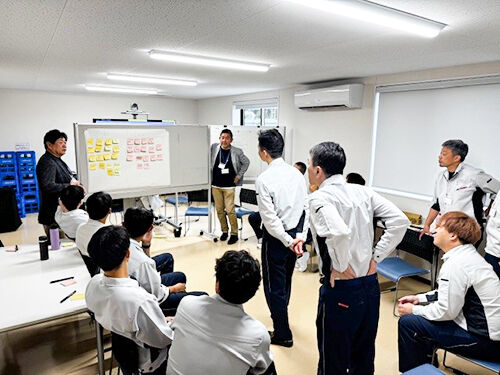
Team building
Forging Strong Labor-Management Relations
We hold meetings of the Labor-Management Council twice a year, where employee representatives selected from each business location communicate with the company, and provide appropriate opportunities for dialogue when regulations are revised and at other times. During these meetings, opinions are exchanged on general working conditions such as working hours, working environment, and wages, forging strong labor-management relations. Resolutions are shared among each business location and made known to employees via the intranet.
- Message from CEO
-
TOYO GOSEI REPORT2025 DOWNLOAD
(Japanese version only) - Toyo Gosei Co., Ltd. in Our Lives
- Toyo Gosei's Business and Sustainability
- Safety Initiatives
- Human Capital Initiatives
- Initiatives for Respecting Human Rights
- Social and Environmental Initiatives
- Initiatives for Business Continuity
- Initiatives for Sound
Corporate Management - Research and Development
- Sustainability Data