

Environmental Initiatives


We believe that it is our fundamental responsibility as a company to utilize chemical technology, the foundation of our management philosophy, to achieve both the "growth of human civilization" and "conservation of the global environment." As we enter a transition where harmony between technology and the environment is needed, we will continue to contribute to the development of technologies that support a sustainable society and industry by improving the reliability of the materials we provide for social infrastructure, such as next-generation semiconductors that support energy conservation and the evolution of AI. We are also focusing on optimizing the entire value chain. We will achieve this by reducing greenhouse gas emissions and promoting resource circulation through the distillation and recycling of high-purity solvents and the streamlining of chemical logistics, as well as by reducing the environmental impacts of our production activities through energy-saving measures and the use of renewable energy. Steadily implementing these initiatives and contributing to resource circulation and decarbonization on a global scale will enable us to help realize a sustainable society in which the environment and growth are in harmony.
Environmental Policy
Targets
We consider environmental conservation and safe operations to be important management issues. Each of our business locations promotes business activities with an internal focus on employee safety and health and an external focus on conserving the local environment.
Legal Compliance
We make sure that all employees comply with environmental conservation laws and regulations and listen to the voices of people in the local community.
Action Structure
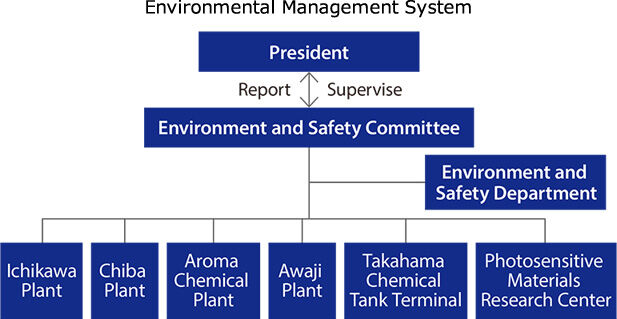
The Company has established an environmental management system with the president at the top and an Environment & Safety Committee chaired by the president and composed of the managers of divisions and each business location. The Environment & Safety Committee meets annually to review the progress of initiatives on environmental issues such as decarbonization, energy conservation, waste management, and recycling, organize requests from both inside and outside the company, confirm the results of the previous fiscal year's decarbonization and energy conservation targets, and formulate annual targets based on those results. In addition, each business location has formed an organization that specializes in environmental safety-related matters, and the Risk Management Committee is held every three months to review the progress of activities and analyze and evaluate risks.
ISO 14001 Certification
Our production bases and chemical tank terminal have established environmental management systems based on ISO 14001. As of the end of September 2025, four of our five bases, excluding the Takahama Chemical Tank Terminal, have obtained ISO 14001 certification (coverage rate: 80%).
Compliance with Environmental Laws and Regulations
Environmental laws and regulations are becoming stricter with each passing year. We are constantly keeping abreast of amendments and thoroughly comply with them within the company. In FY2024, there were no serious violations of environmental laws and regulations. Going forward, we will continue to fully comply with laws and regulations and maintain relationships of trust with society and the local community.
Addressing Climate Change
We recognize that reducing greenhouse gas (GHG) emissions, such as CO₂, a known cause of climate change, is an important issue that we must address as a company. Starting in FY2024, we will also calculate Scope 3 emissions, identify and analyze GHG emissions throughout the supply chain, and plan to use this information to develop measures for future reductions.
Targets and Results
The Company has established the following medium- to long-term environmental targets.
| Targets |
|---|
| ・32% reduction of Scope 1 + 2 emissions by FY2030 (compared to FY2013) ・Achieve carbon neutrality by FY2050 |
| Reduce the intensity of energy usage by 1% year over year |
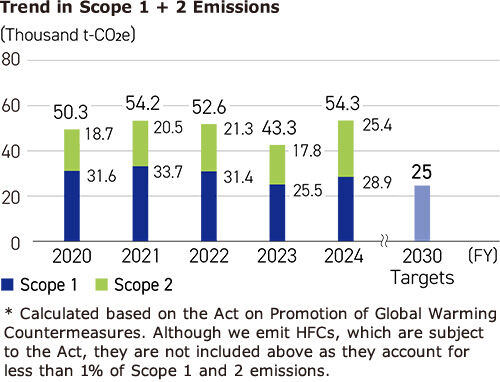
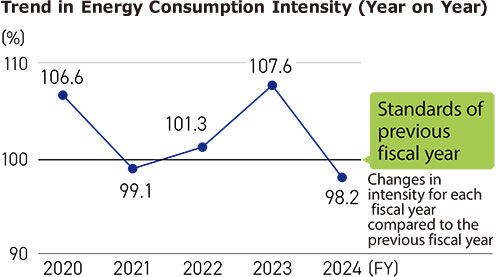
Our CO₂ emissions for FY2024 totaled 54.3t-CO₂e* and the intensity of our energy consumption (the ratio of energy consumption per unit of production) was down 1.8% compared to the previous fiscal year. CO₂ emissions increased due to higher actual production volume. We will continue working to reduce CO2 emissions.
* CO₂e: The amount of CO₂ equivalent to the impact on global warming, including greenhouse gases other than carbon dioxide (CO₂).
Initiatives to Reduce GHG Emissions
Among all industries, the chemical industry is one of the industries with the highest GHG emissions because it uses a large amount of thermal energy for heating and cooling in its production processes. The Company is promoting various initiatives to reduce GHG emissions.
Management and Review of Energy Efficiency of Manufacturing Processes and Equipment
After quantitatively determining the amount of energy consumption per unit of production, we review the energy efficiency of our manufacturing processes and equipment, and check the status of improvements monthly, quarterly, semi-annually, and annually. Based on these results, we repeat the plan-do-check-act (PDCA) cycle of reviewing our medium- to long-term plans, aiming to optimize energy consumption.
Energy Conservation and Energy Transition Initiatives
We are currently implementing an energy usage management project with the aim of setting and implementing energy-saving targets for our production processes. Under this project, we are considering a model that will enable visualization and future prediction of energy consumption.
Additionally, we are promoting a variety of measures, including reviewing our energy supply system, improving our production processes, introducing non-fossil fuel electricity, installing energy-saving equipment, and utilizing LNG boilers, which emit less GHG than heavy oil-fired ones.
Going forward, we are also considering introducing more energy-efficient equipment and technologies. If we fall short of our targets even with these measures, we will consider purchasing carbon credits.
Promoting the Use of Green Electricity
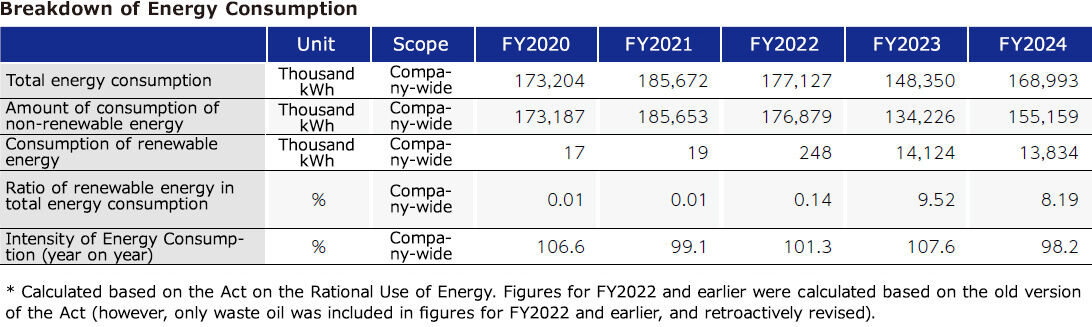
As electricity accounts for approximately 40% of our GHG emissions, we have drawn up a plan to switch to green electricity and are proceeding with the transition in line with the plan. The Awaji Plant began switching to green electricity in FY2022, ahead of our other plants. By FY2023, the Awaji Plant had increased the use of green electricity from 30% to 50%. The ratio of renewable energy in our total energy consumption in FY2024 was 8.19%.
We plan to switch to green electricity at other business locations in the future.
Reducing GHG Emissions Throughout the Supply Chain
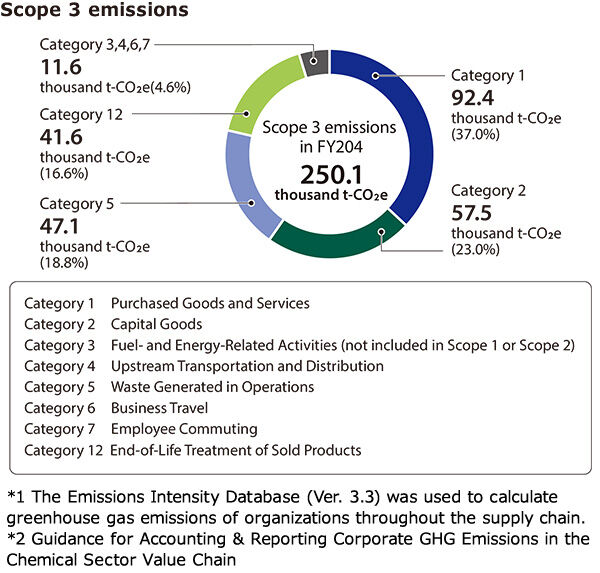
We began compiling Scope 3 emissions in FY2024. Our Scope 3 emissions for FY2024 totaled 250 thousand t-CO₂e, of which Category 1 and Category 2 accounted for approximately 60% of the total.
Calculation of Carbon Footprint
We have begun calculating carbon footprints to quantify the GHG emissions of our products. We calculate GHG emissions from the procurement of raw materials to manufacturing, transportation, use, disposal, and recycling of our products.
The calculation results will be used to develop measures to reduce GHG emissions and will also be shared with business partners to work toward reductions throughout the entire supply chain.
Reducing Waste
We are making use of separation and refining technology that we have cultivated for over 70 years to recycle waste generated internally and used solvents. We have reduced approximately 80% of the waste generated internally through in-house reduction and recycling.
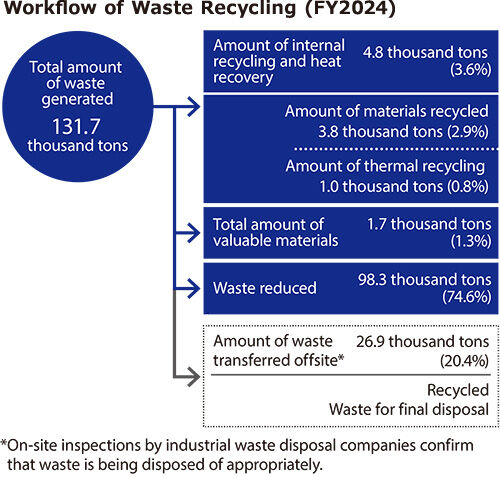
Workflow of Waste Recycling (FY2024)
We are working to distill and refine used solvents at our plants and reuse them after quality control. This requires high-purity technology and is made possible by our advanced technologies and facilities.
We are also promoting efforts to use by-product oil generated during the production process as fuel.
Going forward, we will strive to further increase the amount of reuse and reduce waste through improvements to collection equipment, process refinements, and sorting. We will also strengthen the recycling of waste generated from the production process.
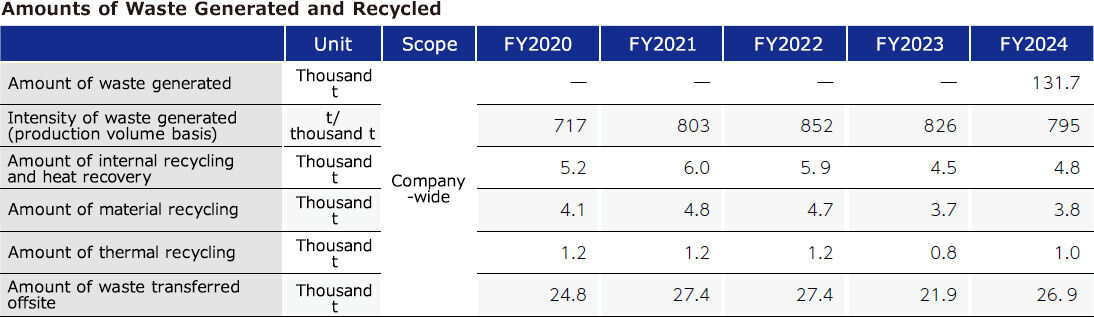
Solvent Recycling Business
Our Chemicals Division (Ichikawa and Awaji plants) is utilizing our technological prowess to develop a solvent recycling business. The amount of recycled material in FY2024 was 2,990 tons. Through our recycling business, we will contribute to a recycling-oriented society.
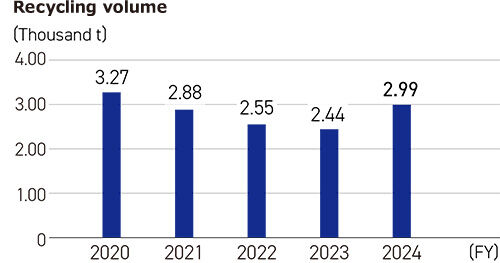
Initiatives to Reduce Environmental Impacts
Reducing Air Pollutants
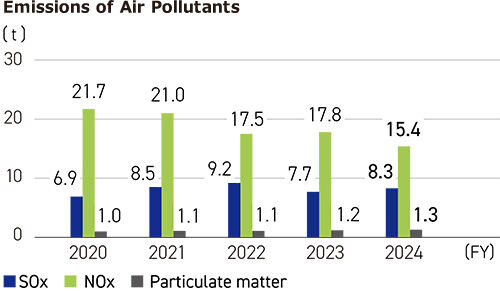
At each of our business locations, we regularly analyze exhaust gas emissions to ensure that they are within environmental standards and to reduce the amount of air pollutants we emit. Recent trends have shown a slight increase in our emissions of nitrogen oxides (NOx) and particulate matter, while sulfur oxides (SOx) have decreased. We are currently considering the introduction of boilers that have an even lower environmental impact.
Water Management and Prevention of Water Pollution
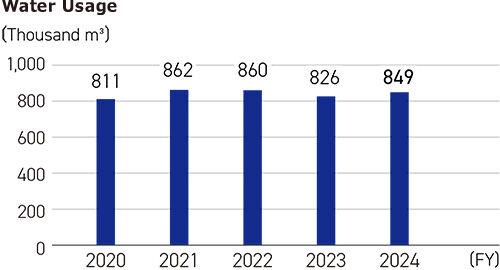
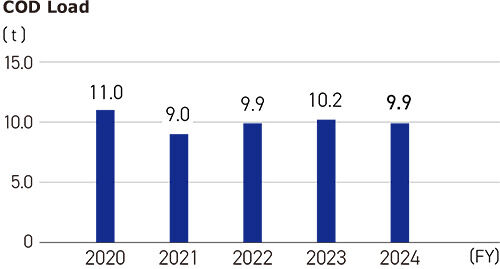
We strive to reduce the amount of water used at each of our plants. We purify wastewater generated in the manufacturing process at wastewater treatment plants until its environmental impact is reduced and release it into bodies of water when its quality is below the wastewater standard value. We manage our water using chemical oxygen demand (COD) meters, total organic carbon (TOC) meters, gas chromatograph mass spectrometers, and other instruments, in an effort to reduce our environmental impact.
Measures to Reduce Emissions of Substances Subject to the PRTR System
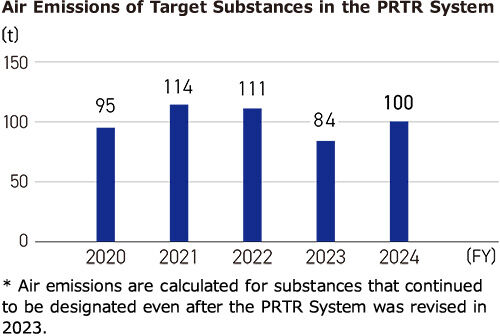
In accordance with the Act on the Assessment of Releases of Specified Chemical Substances in the Environment and the Promotion of Management Improvement (Pollutant Release and Transfer Registers [PRTR] System), we report the amount of Designated Chemical Substances released into the air and transferred. The purpose of the PRTR System is to reduce the environmental impact of Designated Chemical Substances, and we are also promoting the handling and strengthening of management and reduction of emissions of these substances.
Non-financial highlight data can be viewed in the various data sections.
Sustainability Data
- Message from CEO
-
TOYO GOSEI REPORT2025 DOWNLOAD
(Japanese version only) - Toyo Gosei Co., Ltd. in Our Lives
- Toyo Gosei's Business and Sustainability
- Safety Initiatives
- Human Capital Initiatives
- Initiatives for Respecting Human Rights
- Social and Environmental Initiatives
- Initiatives for Business Continuity
- Initiatives for Sound
Corporate Management - Research and Development
- Sustainability Data