

Supplying Responsible Products


Basic Procurement Policy
Mutual Trust
We recognize that our suppliers are important partners in the development of our business. We strive to build trust with them through our procurement activities, aiming for coexistence and mutual prosperity.
Legal Compliance / Ethical Transactions
We will comply with all relevant domestic and international laws and regulations, and conduct procurement activities that take into consideration social norms and corporate ethics.
Fair and Equitable Transactions
Based on the principle of free competition, we provide fair and equitable trading opportunities to all our business partners both in Japan and overseas.
Consideration for the Environment
As a chemical manufacturer, we have a responsibility to procure materials that take into consideration the impacts on the global environment.
CSR Procurement
In order to fulfill our corporate social responsibilities, we will implement CSR procurement that takes safety, the environment, and human rights into consideration.
Promotion System and Mechanism
The Company aims to achieve long-term stable supplies by building a robust and sustainable supply chain. Based on this philosophy and the Basic Procurement Policy established as the foundation of our procurement activities, we work with our suppliers, who are essential partners for our business development, to promote CSR procurement that takes safety, the environment, and human rights into consideration. Our suppliers of raw materials, secondary materials, and packaging materials, which make up the majority of our suppliers, as well as our facility construction and outsourcing partners, are managed by our procurement departments and each plant.
CSR Procurement Guidelines
We have formulated CSR Procurement Guidelines that set out guidelines for activities that take safety, the environment, and human rights into consideration. We ask that our business partners understand and comply with these guidelines. In addition to publicizing these guidelines on our website, we also send them to our business partners, and we ask our raw material suppliers to sign a letter of consent to these guidelines.
1:Consideration for the Environment
- Establish and operate an environmental management system.
- Manage chemical substances used in manufacturing in accordance with laws and regulations.
- Promote efficient use and recycling of resources and energy in manufacturing processes.
- Appropriately manage wastewater, exhaust gases, and waste disposal as part of efforts to protect the global environment.
2:Quality and Safety of Products and Services
- Establish and operate a quality management system.
- Ensure that products and raw materials comply with safety standards required by law.
- Accurately disclose product information to our customers.
3:Health and Safety in the Workplace
- Implement appropriate safety measures for tools and equipment used by employees.
- Provide occupational safety education and training and conduct periodic reviews.
- Monitor and manage workplace hygiene, odors, and temperature, and promote improvements.
4:Respect for Human Rights and a Sound Working Environment
- Prohibit forced labor and child labor.
- Pay statutory minimum wages and overtime allowances.
- Comply with statutory working hours and grant rights to annual paid leave.
- Do not discriminate based on race, age, sex, gender, nationality, or other attributes.
- Maintain a safe and clean working environment and give due consideration to employee health management.
5:Compliance with Laws, Regulations and Social Norms
- Comply with laws and regulations such as the Companies Act and the Antimonopoly Act, and conduct fair transactions.
- Do not provide or solicit excessive entertainment or gifts that exceed the scope of social courtesy.
- Completely avoid involvement with antisocial forces.
- Appropriately manage intellectual property to avoid infringing on others' rights or having our technologies and know-how infringed.
- Comply with laws and appropriately manage the import and export of regulated goods.
- Confirm that raw materials used in products do not stem from conflict minerals or contribute to human rights violations or environmental harm.
6:Contributions to the Local Community and Society
- Deepen communication with local communities where our company and related facilities are located, and engage in activities that contribute to the development of local economies, culture, and education.
7:Research and Development for the Future
- In addition to advancing our business activities, we conduct research and development that contributes toward a sustainable society.
8:Disclosure of Information to Stakeholders
- To uphold social responsibility and high corporate ethics, we strive for timely and appropriate disclosure of business activities, management conditions (including financial status and performance), and risk-related information as required by law.
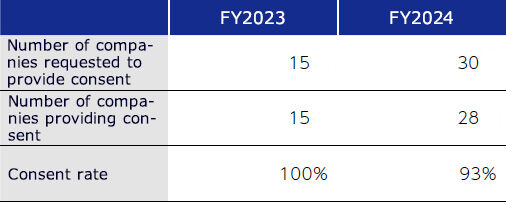
CSR Procurement Guidelines Survey
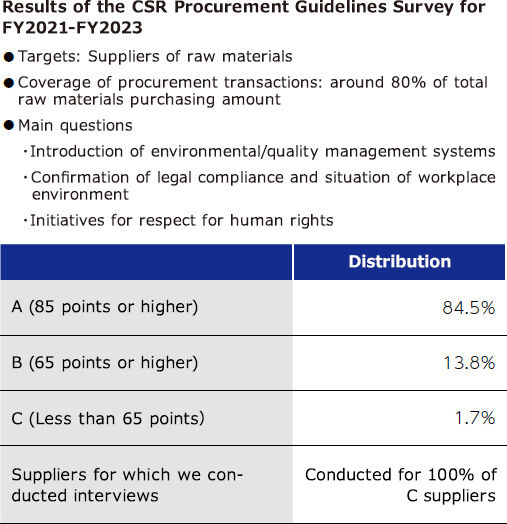
We conduct a CSR Procurement Guidelines Survey of our raw material suppliers every three years, with the aim of understanding the status of their efforts to consider safety, the environment, and human rights. The other aim is to have suppliers check their own activities and use this as an opportunity to make improvements. The survey results are rated on a three-point scale from A to C. Suppliers that score a C are interviewed individually to understand their procurement practices, and if certain standards are not met, we request improvements or corrections.
Selection of New Business Partners
When initiating a new business relationship, we prepare a questionnaire that includes items such as (1) company information, including financial status, (2) quality and environmental management system certification status, and (3) ESG risk-related information (whether there have been any past accidents or violations of laws and regulations, etc.). With the questionnaire, we conduct an evaluation to determine whether there are any risks associated with the transaction.
Initiatives for Stable Supply
We supply products that are directly related to our daily lives to a wide range of industries, including the electronic materials industry as well as fragrances, pesticides, and food, among others. To ensure stable production and supply of our products, we analyze the risks associated with each raw material and product and take measures to ensure stable supply. Specifically, we take various measures depending on the situation of each product, i.e., considering production plans based on customers' medium- to long-term demand forecasts, establishing mutual backup systems between production plants, and stockpiling product and raw material inventories and decentralizing storage locations. We also strive to ensure stable raw materials procurement by quickly identifying risks and taking measures such as selecting multiple suppliers even during normal times.
Responsible Minerals Procurement
Responsible Minerals Procurement Policy
As a global company, we recognize the issue of conflict minerals as a serious social issue from the perspective of social responsibility and compliance. We will select suppliers of tantalum, tin, tungsten, gold, cobalt, mica, and other minerals in a manner that ensures they do not contribute directly or indirectly to serious human rights violations or conflicts.
This policy also relies on the Due Diligence Guidance for Responsible Supply Chains of Minerals from Conflict-Affected and High-Risk Areas of the Organisation for Economic Co-operation and Development (OECD), of which Japan is a member.
Initiatives for the Responsible Procurement of Minerals
We conduct surveys on conflict minerals (tantalum, tin, tungsten, gold, cobalt, mica, etc.) of all suppliers from whom we procure raw materials. The surveys are carried out through interviews regarding the use of conflict minerals when starting new business relationships as well as through similar interviews in our CSR Procurement Survey.
RSPO Certification
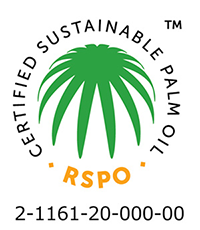 In 2021, we obtained certification from the Roundtable on Sustainable Palm Oil (RSPO) with the aim of preventing deforestation in rainforests caused by the development of new plantations for palm oil, the raw material for palm oil, and serious human rights issues for local residents and plantation workers in producing countries.
Halal Certification
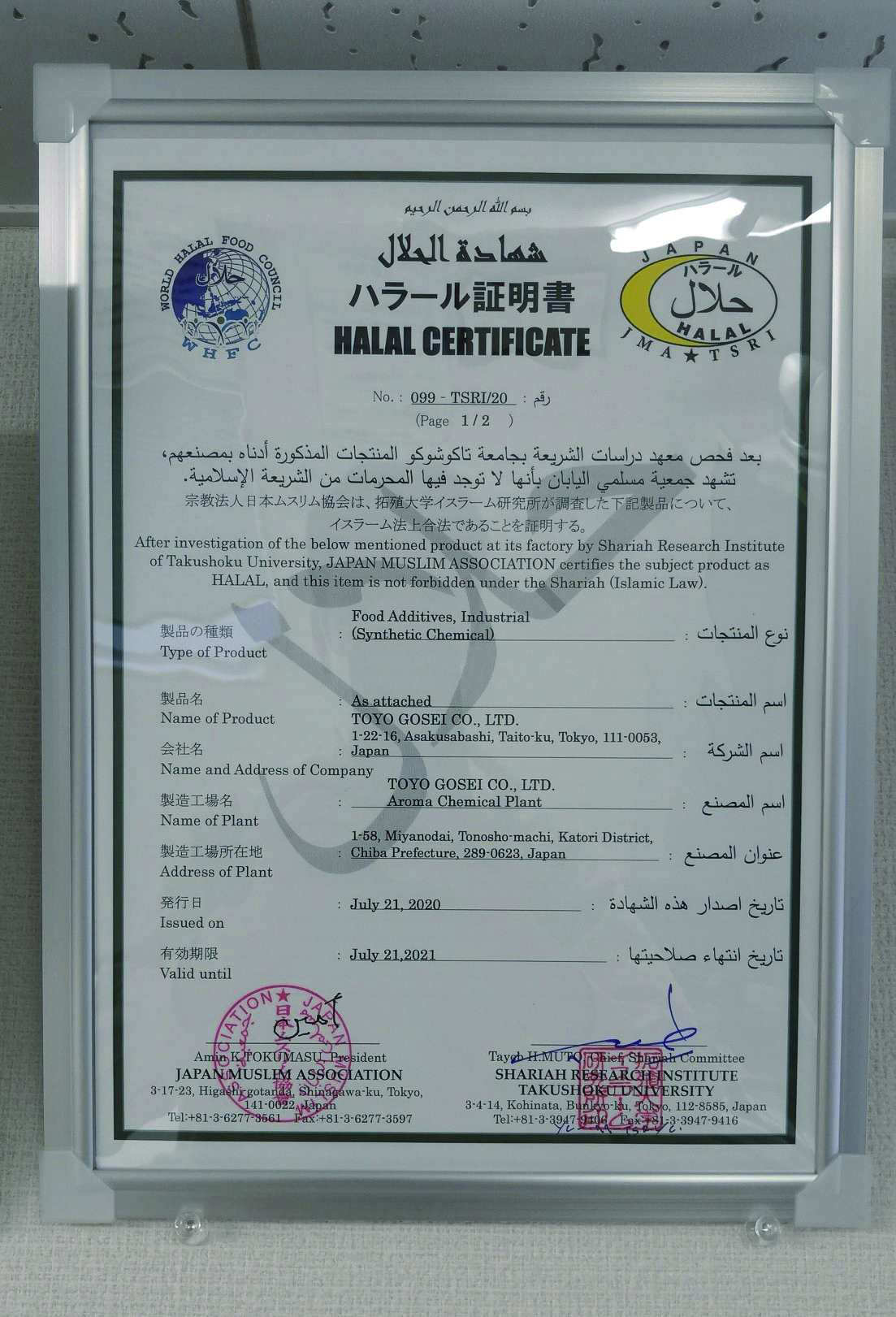 The Company has obtained Halal certification from the Japan Muslim Association for products manufactured at its Ichikawa Plant and Fragrance Plant. "Halal" means "permissible," and Halal-certified products are essential to the daily lives of Muslims. Our products are exported worldwide, including to North America and Europe, and by obtaining Halal certification, we are able to provide products that can be used with confidence by the world's Muslim population, estimated at over 1.8 billion people. In recent years, interest in Halal products has been increasing globally, not only among Muslims but also among non-Muslims, and demand for Halal-certified products is expected to grow significantly.
- Message from CEO
-
TOYO GOSEI REPORT2025 DOWNLOAD
(Japanese version only) - Toyo Gosei Co., Ltd. in Our Lives
- Toyo Gosei's Business and Sustainability
- Safety Initiatives
- Human Capital Initiatives
- Initiatives for Respecting Human Rights
- Social and Environmental Initiatives
- Initiatives for Business Continuity
- Initiatives for Sound
Corporate Management - Research and Development
- Sustainability Data